


_png.png)
_png.png)
Notice:
The SCTi-MAP (Integral Sentence Completion Test — Maturity Assessment Profile) and its associated scoring materials, methodology, and training protocols are the proprietary work of Dr. Susanne Cook-Greuter. According to the Congress of Library registration of my scoring compendium, no part of the registered material may be distributed without my expressed permission. If you have distributed, reproduced, or adapted it without my expressed permission, please contact me.
The Leadership Maturity Framework
(LMF)
The LMF is part of Ego Development Theory (EDT). EDT is a theory of how self-identity forms and expands. It is based on and amplifies Jane Loevinger’s EDT 1970). It addresses the whole person from three main dimensions: Thinking, Being and Doing. It shows how meaning making can evolve.
The LMF is based on research that documents the human potential for life-long transformation. As human beings, we face challenges through life. From a developmental perspective, what changes are not the basic challenges that human beings encounter in life, but the relationship to these challenges that a person can have.
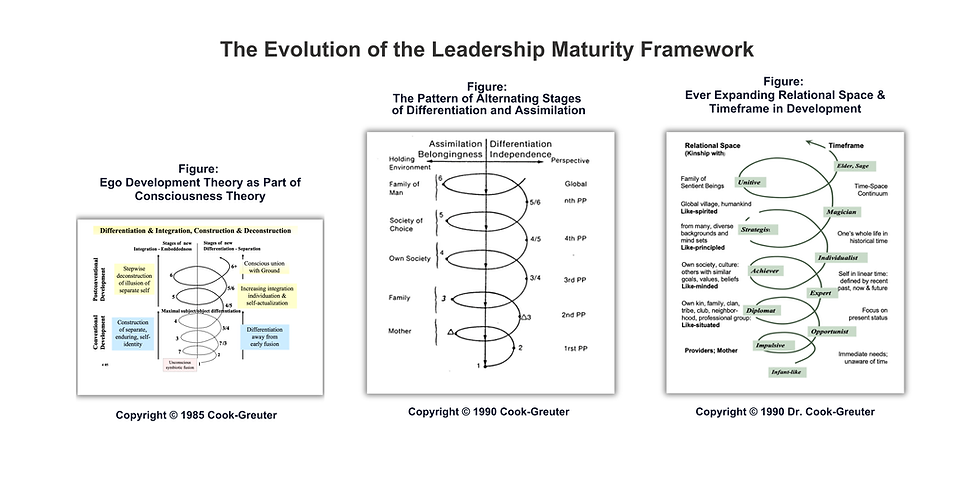
Although the Leadership Maturity Framework (LMF) (as an official name) was first appeared in my dissertation published by Integral Publisher in 2010, my journey exploring EDT began in 1979. I learned then in Master’s program at Harvard how to score Sentence Completion Tests (SCTs) professionally from Professor Harry Lasker. Once I began scoring for others’ research projects, I noticed responses in the data that the scoring manuals by Loevinger, Wessler and Redmore (1970) and later Hy and Loevinger (1996) could not adequately explain and score. In 1985, I first proposed the structure of increasing capacity to take a perspective on experience (external) and on the self (internal) at a symposium of the Society for Research in Adult Development. Based on the rare, yet highly suggestive data I had collected up to then, I was also able to document two stages to replace Loevinger’s vague Integrated stage. They provided clear criteria that distinguished them qualitatively from earlier stages and each other. They followed the overall structure of repeating cycles of differentiation and integration into ever larger interconnected systems of meaning apparent to the self. Self-awareness seems to move from first noticing concrete, external features, to traits, to behavior patterns, to awareness of how patterns are acquired via cultural conditioning, to seeing interrelated systems, and finally, to see through the attempts of the ego to codify and explain reality. At that symposium in 1985, I presented the two new stages and the 5 levels of perspective-taking.


I worked on collecting more data and refining the theory and the measuring tool for 15 years as an independent scholar before I re-entered Harvard University to earn a doctorate in human development and psychology. I intended to eventually be able to test whether my conjectures about EDT were more than an unproven hypothesis. By the time I finished my dissertation in 1999, I had over 4500 SCTs or more than 150,000 pieces of evidence.
Growing up in a multi-lingual society, and being trained in linguistics and especially semantics at the University of Zürich in Switzerland, I was primed to pay attention to minute differences in language usage, context and meaning shifts over time in a way that Loevinger’s research team was not. Initially I added interesting examples and new potential categories to enrich and sometimes correct Loevinger’s manuals. Eventually, our efforts became increasingly more complex and different from both the original manuals (1970, 1978) and the 1996 revised edition.
The Leadership Maturity Framework (LMF) is the narrower term for EDT used in leadership development contexts. It has evolved further over time through additional research, refinement, and my on-going collaboration with others at Cook-Greuter & Associates. The LMF is a far more comprehensive, dynamic, and complex theory than Loevinger’s original contribution to the field. While many people are particularly interested in the high-end of human potential, the mature stages and ego-transcendence, my describing of the underlying structure of development seems to me just as valuable a contribution.
The LMF is best understood as one of the several models that chronicle the different levels of development. Bill Torbert coined the term action logics for the stages found in today’s professional world.
The vertical spiral appearance of the above diagram focuses on just one the aspect of ongoing differentiation-integration aspect of EDT. It is not to be seen as a simple hierarchy, a linear progression or a stair-case as depicted in most adult development theories. The growth toward ego maturity in EDT is best represented by an arc or an inverted U-curve as depicted in Figure 1. It is not depicted as a typical Western progressive onward and upward movement. This is a significant difference between EDT and other developmental models. It emerged from the empirical data itself. Read more...


The LMF maps nine levels of increasing embrace, outlining the characteristics of the stage sequence. Each level or stage represents a distinct, qualitatively different, uniquely defined, and increasingly complex view of self and reality.
Let me remind the reader that all stage descriptions are idealizations. This also goes for the other AD theories. Differences among theories occur because different scholars focus on different aspects of reasoning, behavior and the human experience. Thus, EDT describes the ideal outcome of healthy development for each increase in self-integration and perspective taking. No individual fits all aspects of these descriptions. The sequence serves as a road map, as a way for individuals to orient themselves about how they currently see reality and themselves. Unlike other theories, the EDT roadmap emerged from exploring empirical evidence from MAP tests about how self-identity evolves over time. It shows what individuals at a given stage have already mastered, what characterizes their current level of understanding and meaning making, and what their growth edge and potential for further unfolding might be towards further integration, maturity and wisdom. Though helpful, the roadmap is not written in stone. Read more...
Later (higher) is not necessarily better than earlier meaning making,
wellbeing is a matter of optimal fit with the environment
Unlike other theories which propose and describe later stages as ever more ideal and better ways of being, EGO DEVELOPMENT THEORY shows how each new stage has its own strength and deeper insights as well as its stage-specific vulnerabilities and new forms of unhealthy expression. As Loevinger noted a long time ago, later is not happier or more adapted. On the contrary, with greater awareness comes also greater awareness of unresolvable dilemmas and paradoxes in life. As emphasized before, from a Construct-aware perspective, it is useful to give multiple representations of the same territory of experience as various representations point out different areas of focus and their dynamic interrelationships.
(Cook-Greuter, 2014).


The Maturity Assessment Profile
(MAP)
The MAP is the Sentence completion test that measures a person’s ego development. It was also formerly referred to as the Leadership Development Profile (LDP) and the Integral Sentence Completion Test (SCTi). The tests don’t just give a final stage as a result. Instead, all versions are accompanied by a lengthy report and a personal analysis of what the unique responses reveal about the writer’s meaning making.
History: I expanded the MAP and its analysis since 1980 out of Loevinger's Washington University Sentence Completion Test (WUSCT). I have revised the scoring method and manual several times over the years, adding additional examples, categories; especially adding components to analyze the underlying "structure of thought" as expressed through "language". The most recent scoring manual was updated and released in 2021.
The MAP is the most rigorously developed, Harvard-tested, field-aware and reliable stage measure available. My data base consists of over 10,000 MAPs. The original Harvard dissertation was published by Pro Quest dissertation services, publication #9933122 in Sept. 1999. It was republished by Integral Publishers in 2010 (ISBN: 978-1-4507-2515-6) in their dissertation series. The Harvard study alone was based on over 4000 SCTs . The study is cited as a ground-breaking full-spectrum theory of ego development.
%2C%20Postautonomous%20Ego%20Development-%20A%20study%20of%20its%20nature%20and%20measurem.png)

The MAP goes beyond the original instrument in the range of mature worldviews it covers and in its expanded stage descriptions and broad field of application.
The MAP-test identifies the center of gravity. We define the center of gravity as the preferred level of ego maturity to which a person has consistent access to under ordinary circumstances without special support conditions or unusual stress situations. In other words, the measured ego maturity stage is the one that a person reliably and routinely uses in response to everyday life. However, in our experience people respond from many stages. Never fewer than three adjacent ones.
Development in its deepest meaning refers to transformations of consciousness. This occurs through the interplay among person, culture, and environment, not just by one or the other. Because acquisition of knowledge is part of horizontal growth, learning about developmental theories is not sufficient to help people to transform. Only specific long-term practices, self-reflection, action inquiry, and dialogue as well as living in the company of others further along on the growth path has been shown to be effective over time. The culture of the environment that a person lives in also influences who thrives and develops and who is held back.
If you want to know your level of leadership maturity and personal integration, the MAP is one possible answer.If you just want to know how smart you are and how well you can reason about a topic, there are several tests available that can measure your cognitive ability accurately. In contrast, the MAP assesses the stage of your overall maturity. The MAP uses a full range of stimuli and topics to assess you as a whole person. It looks for your level of self-awareness, self-identity, behavioral patterns, cognitive complexity, emotional intelligence, relational capacity, coping strategies, stress management, preferred defenses and values).
Highly-educated, trained, and certified scorers assess your MAP responses using Dr. Cook-Greuter's extensive scoring manuals, plus incorporating precise scoring rules. The process of matching a response to those listed in the manuals is a clear advantage in terms of inter-rater reliability, and scientific rigor. Scorers will next comment on the unique strengths and vulnerabilities of your way of making sense of experience as well as identify the themes and concerns you express. You'll find out your center of gravity, and the trailing and growing edge of your worldview. While rigor in scoring presents the science of this instrument, commenting and making actionable recommendations is an art.

Applications of the LMF & the MAP
The MAP is a sophisticated and well-researched instrument. It has been used both as a diagnostic tool and as basis for feedback and developmentally-oriented coaching with clients and organizations. In addition, it has been applied in education, academic research and psychotherapy.
Please visit the Associates page to look for professionals and companies that can assist you in any of those needs.